Batch size

Recipe scale calculator

Increase or decrease a recipe in exact proportion, eggs included, with a shopping list of the new amounts.

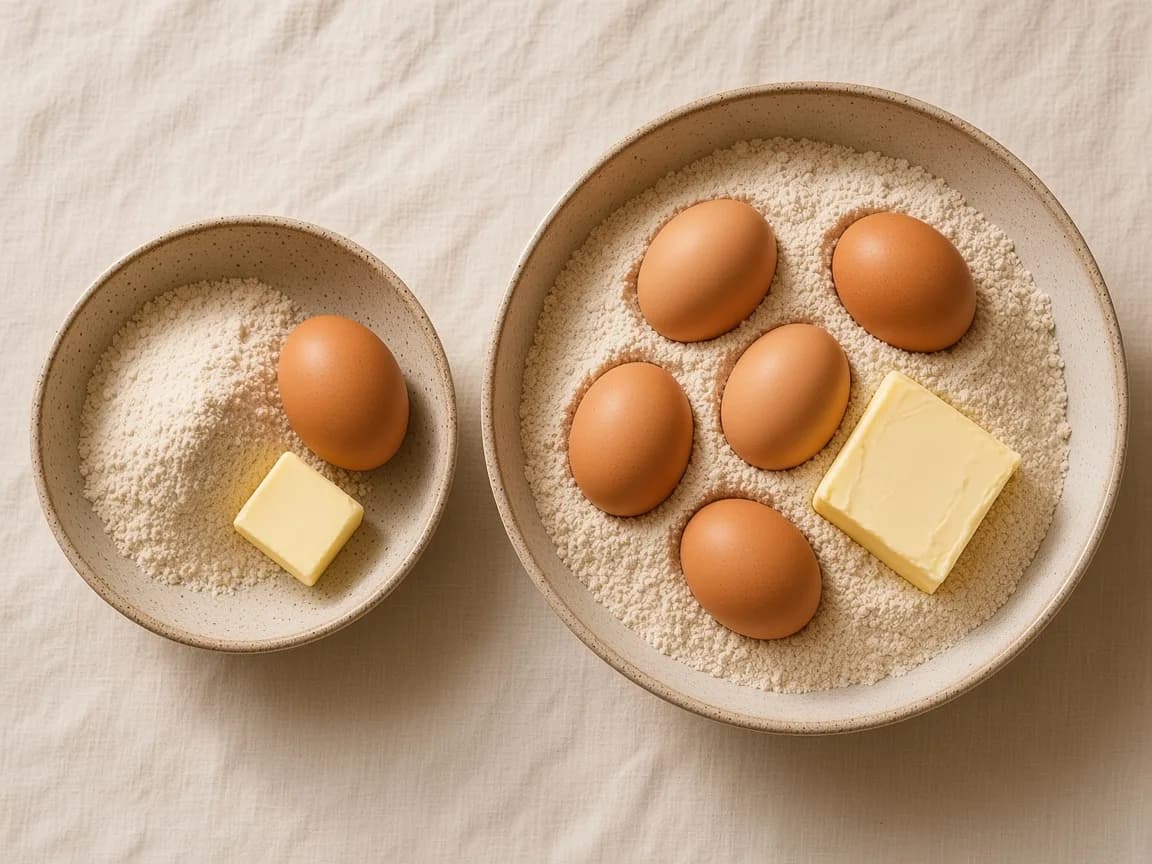
A small bowl of flour, one egg and butter beside a larger bowl of the same

How to use it

  1. Enter Original servings and Desired servings. Both have to be greater than zero.
  2. Add each ingredient with its name, amount and unit. Name eggs so the row is recognised, and use Pieces for a countable egg.
  3. Scale the recipe. Blank rows and zero amounts are left out.
  4. Cook the scaled amounts. If an egg or a piece is not whole, the shopping list tells you how many to buy. The amount to use stays the fraction.

What this calculates

Use this when a recipe you already cook has to feed a different number of people. You enter the original servings, the servings you want, and each ingredient. Every amount, eggs included, is multiplied by the same factor. The calculator does not rewrite the milk to hide a fraction of an egg.

How it works

The factor is desired servings divided by original servings. Each amount is the original times that factor, with no extra rounding step. A fractional egg or piece gets a whole count to buy, rounded up, listed separately from the amount you use. Salt, spices, garlic, yeast and baking powder still receive the proportional amount, plus a warning, because they often should not be scaled in a straight line. Any rounding to a spoon you can measure is your choice.

Worked examples

From 4 servings down to 1

Inputs
Original servings 4, desired servings 1. Eggs 1 piece, milk 200 ml, all-purpose flour 120 g, salt 2 g.
Calculation
The factor is 1 divided by 4, which is 0.25. Every row is multiplied by 0.25. Nothing else is adjusted.
Result
0.25 eggs, 50 ml of milk, 30 g of flour and 0.5 g of salt.
What it means
Beat one egg, weigh it, and use a quarter of that weight. Do not pour in a whole egg and take milk out to compensate. This calculator will not do that for you.

From 4 servings up to 7

Inputs
The same ingredients, with desired servings set to 7.
Calculation
The factor is 7 divided by 4, which is 1.75. Milk moves only by that factor. The egg does not borrow from it.
Result
1.75 eggs, 350 ml of milk, 210 g of flour and 3.5 g of salt. Buy 2 eggs.
What it means
Use 1.75 eggs in the bowl and buy two. The salt line is the proportional amount. Add most of it, then taste, because salt does not always scale in a straight line.

Limitations and common mistakes

  • Yeast, baking powder and baking soda can over-rise in a large batch. The warning is there so you can start a little lower.
  • The pan, the oven time and how much water steams off are not part of this factor.
  • A row with no name or an amount of zero is skipped, so a half-finished line will not appear in the result.
Common questions

FAQs

Scale the amounts, then cook and taste. Salt, spices and raising agents rarely move in a perfect straight line.

Made for home chefs

Your next good meal starts here.

Keep your favorite recipes close, give your week a plan, and make everyday cooking easier with Chefalia.

  • Download on the App Store
  • Get it on Google Play